
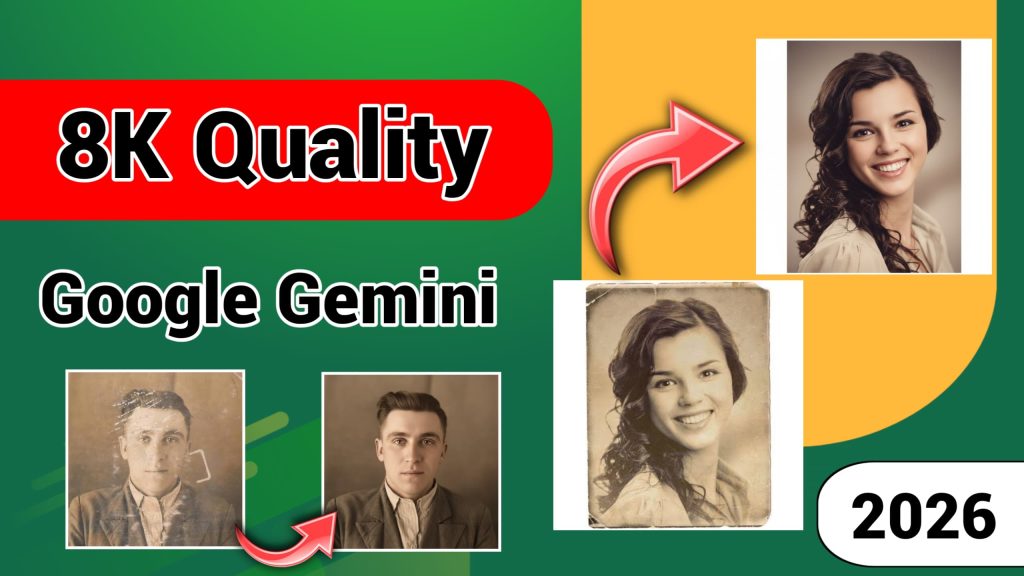
How to Restore Old Photos to 8K Quality Using Google Gemini (2026 Guide)
Many of us have a box of old, faded family photographs tucked away in a cupboard. These images often suffer from scratches, blurriness, or low resolution, making it hard to appreciate the precious memories they hold. People are increasingly searching for ways to bring these photos back to life without spending hundreds of dollars on professional restoration services. In this guide, you will learn exactly how to use the latest AI technology to transform a grainy, vintage picture into a crystal-clear, 8K resolution masterpiece. We will provide a specific, tested prompt that you can use right away to get high-fidelity results.Restore Old Photos
What is Google Gemini for Photo Restoration?
Google Gemini is a state-of-the-art artificial intelligence developed by Google, capable of understanding and generating high-quality visual content. Unlike basic filter apps, Gemini uses deep learning to “understand” human facial structures, fabric textures, and background elements. It is an essential tool for historians, genealogists, and anyone who wants to preserve family legacies. Currently, Gemini offers a robust free tier that allows for image generation and editing. While a simple signup with a Google account is required, the accessibility and power it provides make it a top choice for intermediate users who want professional-grade results without complex software like Photoshop.Restore Old Photos
Key Features of Gemini Photo Restoration
- AI Face Reconstruction: Gemini analyzes blurred facial features and reconstructs them with realistic skin textures, ensuring the person looks like their true self rather than a “plastic” version.
- 8K Resolution Upscaling: It doesn’t just clean the photo; it adds pixels and detail, allowing you to print old wallet-sized photos onto large canvases without losing sharpness.
- Cinematic Lighting Correction: The tool can identify poor lighting in the original vintage shot and apply a balanced, cinematic glow that makes the subject stand out.
- Automatic Scratch and Noise Removal: Gemini identifies physical damage like cracks, dust, and film grain, intelligently filling those gaps with matching textures.
- Texture Preservation: Unlike older AI tools that blur everything to hide noise, Gemini maintains realistic pores, hair strands, and fabric weaves for a photorealistic finish.
Step-by-Step Guide to Restoring Your Photos
Step 1: Prepare Your Digital Copy
Before opening the tool, ensure you have a clear digital version of your old photo. If the photo is physical, use a mobile scanner app or a high-quality camera to take a steady, well-lit picture of it. Avoid glares from overhead lights, as these can confuse the AI.
Step 2: Access Google Gemini
Go to the official Google Gemini website or app. Sign in using your Google credentials. Once logged in, you will see a chat interface with an “Upload” or “Plus (+)” icon near the text bar. This is where the magic starts.Restore Old Photos
Step 3: Upload the Vintage Image
Click the upload icon and select your low-resolution photo from your device. You will see a thumbnail of your image appear in the chat box. This confirms the AI has received the visual data it needs to analyze.
Step 4: Input the Professional Restoration Prompt
In the text box, do not just type “fix this.” Instead, copy and paste the specialized restoration prompt provided at the bottom of this article. This prompt tells the AI to act as an expert and focus on specific details like skin texture and 8K fidelity.
Step 5: Review and Refine
Once you hit enter, Gemini will process the image. Within seconds, you will see a high-definition version on your screen. Look closely at the eyes and mouth. If something feels off, you can type a follow-up command like, “Make the eyes slightly darker to match the original,” and the AI will adjust it.
Step 6: Download the High-Res File
Click on the generated image to expand it, then look for the download icon. Save it in the highest format available to ensure you keep that 8K crispness for future printing. Restore Old Photos
Pro Tips for Better Results
- Use Natural Descriptions: If you know the original color of the clothes or the person’s eyes, add that detail to the prompt. For example, “The blouse was originally light blue.”
- Avoid Over-Smoothing: If the result looks too much like a cartoon, ask the AI to “increase skin grain and realistic imperfections” to make it look more like a real photograph.
- Source Quality Matters: Even though the AI is powerful, starting with the least blurry version of the photo will always result in a more accurate reconstruction of the person’s identity. Restore Old Photos
Common Mistakes to Avoid
- Using Vague Prompts: Simply saying “clean this photo” often leads to generic results. The AI needs technical instructions like “8K resolution” and “photorealistic texture” to perform at its best.
- Ignoring Background Elements: Beginners often focus only on the face. Ensure your prompt mentions the background so the AI doesn’t leave it blurry or create something that doesn’t fit the era.
- Multiple Faces in One Go: If a photo has five people, the AI might struggle with detail. For the best 8K results, try to crop and restore important faces individually if the group shot comes out messy.
Is It Safe and Legal?
Using Google Gemini for personal photo restoration is entirely safe and legal. Since you are uploading your own family photos, you hold the rights to the original content. Google’s platform is built with high security standards to protect your data. However, always ensure you are using the official Google Gemini website and avoid third-party “clones” that might ask for unnecessary permissions or payments. Restore Old Photos
FAQs
Can I restore a photo that is torn in half?
Yes, AI can often “inpaint” or fill in missing sections by analyzing the remaining parts of the photo, though it may require a bit of trial and error with the prompt to get the symmetry right.
How long does the restoration process take?
Usually, it takes between 10 to 30 seconds for the AI to analyze the image and generate a high-resolution 8K version, depending on your internet speed.
Does it work on black and white photos?
Absolutely. You can use the same prompt for black and white photos, or you can specifically ask the AI to “colorize with natural, historically accurate tones” during the process.
Is there a limit to how many photos I can restore?
While the free version has a generous usage limit, very high-frequency users might hit a temporary cap. For most users restoring a family album, the free tier is more than enough.
Conclusion
Restoring old photos is no longer a task reserved for expensive studios. With the power of Google Gemini and the right professional prompt, anyone can turn a faded piece of history into a vivid, 8K masterpiece. It is a rewarding process that allows you to see your ancestors in a light you never thought possible. We encourage you to grab an old photo today, use our prompt, and witness the transformation for yourself.
This website is not officially affiliated with Google Gemini. All trademarks belong to their respective owners.
Restore Old Photos
Copy Prompt Section
Copy the Full Working Prompt
Click the button below to copy the prompt directly to your clipboard.
Prompt to Copy:
“Act as a professional photo restoration expert. Analyze the features, clothing, and background of this uploaded vintage image. Recreate it in ultra-high definition 8K resolution. Ensure the faces are sharp, skin textures are realistic with visible pores, and lighting is cinematic. Enhance every detail while keeping the original essence and facial identity 100% intact. The result should be photorealistic, crystal clear, and high-fidelity.
Read Also: How to use AI for professional editing”
Google Veo AI Video: How to Create Viral Police Protocol Videos